At 8:30 on a weekday morning, a tonneau-shaped watch does not disappear beneath a shirt cuff. It changes the whole outline of the wrist. That is why SuperCloneWrist Richard Mille watches need a different review process from ordinary round sports models.
The skeleton dial usually creates the first reaction. However, case curvature, visible thickness, screw placement and strap shape decide whether the watch still looks balanced after several hours. A strong selection process should therefore begin with proportion, continue through dial architecture and finish with current version and QC confirmation.
The dial should not lead the decision alone.
A useful review needs a straight front image, a crown-side profile, the opposite case side, a caseback view and a wrist-scale video whenever those materials are available. Without those angles, case curvature and real wrist height remain guesses.
Why Richard Mille Needs Case Shape Checks
A round watch gives the eye one simple outline. By contrast, a Richard Mille-style case creates several outlines at once. The upper curve, lower curve, sidewall, crystal edge and strap connection remain visible during an ordinary movement of the hand.
Consider a watch resting beside a laptop during a 45-minute meeting. The dial may face upward for only a few seconds. Most of the time, the case appears from an angle, so the side profile carries more visual weight than a polished front photograph suggests.
This is where many large watches lose their balance. A case can have the expected overall length yet still look flat across the wrist. Meanwhile, a strongly curved tonneau profile can make a substantial case feel more controlled because the upper and lower sections follow the arm instead of hovering above it.
With superclonewrist richard mille watches, the first useful check is the outer silhouette. The distance between the widest side points, the taper near the strap and the curve along the crystal create the recognizable shape before dial colour or movement decoration enters the picture.
The Front View Should Look Controlled
From the front, a tonneau case needs tension. The sides should bow outward without becoming soft or balloon-like. Likewise, the top and bottom should feel related, even when a model uses a layered bezel or a complicated internal structure.
A practical comparison takes less than two minutes. Place the product image beside a straight design reference, then mentally remove the dial. When the empty case outline still looks recognizable, the silhouette is doing its job.
However, an attractive dial can hide a weak outline. Bright accents, polished bridges and white straps pull attention inward. Once those details are removed from the visual equation, an overly broad bezel or a narrow middle case becomes easier to notice.
Top-to-bottom balance matters as well. The area above 12 o’clock should relate naturally to the space below 6 o’clock. A small difference can be intentional, but a large imbalance may make the dial appear to sit too high or too low inside the case.
The Side View Often Matters More Than the Diameter
Diameter figures help, although they do not describe how the watch occupies the wrist. A 49 mm case with strong curvature can sit more naturally than a smaller case with straight strap exits. Therefore, side photographs deserve the same attention as the headline measurement.
During a commute, the difference becomes obvious. A flat case tends to shift when a jacket sleeve presses against one edge. In contrast, a curved case spreads contact across the wrist and usually appears less top-heavy during ordinary movement.
The useful side image should show the entire vertical stack. That means the crystal, bezel, middle case and caseback should remain visible in one frame. A crop that removes the lower caseback can make the watch look thinner than it may feel in regular wear.
Caseback height changes the real wrist position. A raised centre can lift the entire watch, even when the bezel looks slim from above. As a result, the case may rock slightly when the wrist moves from a keyboard to a phone.
Strap Exit Angle Changes the Whole Silhouette
Integrated rubber straps do more than hold the watch in place. They continue the case shape. When the first strap section points downward early, the watch wraps the wrist; when it travels outward for several centimetres, the whole piece wears wider.
This detail matters on wrists around 6.5 inches, although wrist shape matters as much as circumference. A flatter wrist may support a broader case, while a rounder wrist can make the same strap stand away near the attachment points. A low side image gives more information than a measurement alone.
Meanwhile, strap thickness should match the case mass. A thin strap beneath a tall case makes the watch look disconnected. A strap with enough volume creates a smoother transition, particularly when viewed from two metres away across a table.
Colour changes apparent size too. White ceramic-style cases and white straps reflect more light, so they appear broader in daylight. Dark titanium-style cases usually feel more compact, even when the measurements remain close.
Four Angles Worth Requesting
- Straight front: case symmetry, bezel width and top-to-bottom balance.
- Crown side: thickness, crown position, caseback height and strap exit.
- Opposite side: uninterrupted curvature and visible case-layer spacing.
- Wrist video: scale during a normal bend and turn of the hand.
Skeleton Dial and Movement Appearance Notes
A skeleton dial removes the quiet background found on a conventional watch. Instead, bridges, wheels, screws, hands and the inner flange compete inside the same opening. The result can be striking, but only when those layers remain organized.
For superclonewrist richard mille watches, visual depth matters more than the number of exposed parts. A busy dial is not automatically convincing. In fact, too many shiny elements at one level can make the mechanism look printed rather than built in layers.
Under a desk lamp at 9:00 in the evening, a strong skeleton dial shows several planes. The hands sit above the indices, the indices sit above the bridge structure and darker movement parts recede beneath them. That separation creates the mechanical character associated with an openworked design.
Depth Comes From Shadows, Not Extra Decoration
Small shadows create most of the three-dimensional effect. A raised marker casts a narrow line onto the structure below. Likewise, a separated bridge edge changes tone when the watch turns ten or fifteen degrees under indoor light.
Flat decoration behaves differently. The whole surface changes brightness at once, so the dial looks like one plate covered with a mechanical pattern. Therefore, angled images provide more value than a heavily lit straight photograph.
A short video can reveal this difference in seconds. As the watch rotates slowly, distinct layers should appear and disappear at different moments. When every part flashes together, the architecture often lacks enough visual separation.
Open space also needs rhythm. One large empty area beside a dense group of gears can pull the dial to one side. A successful layout feels complicated at first, then becomes easier to read after several seconds.
Legibility Still Matters
Mechanical detail should not erase the time display. At arm’s length, the hour and minute hands need enough contrast against the structure below. White, silver or coloured hand edges can help, provided the finish remains clean and consistent.
For example, glance at the dial for one second while standing near a window. When the hands disappear until the wrist reaches one particular angle, the colour combination may feel tiring during regular use. A complex dial should reward a closer look without demanding one every time.
The chapter ring supports legibility too. Clear minute marks frame the mechanism and give the eye a stable outer reference. When the ring sits unevenly or disappears behind a broad bezel, the centre can look visually loose.
Dial colour should also support the intended wardrobe. A black-and-silver skeleton layout works easily with charcoal knitwear, dark denim and plain shirts. A white case creates a stronger frame, so the movement treatment usually benefits from darker contrast.
Visible Movement Finishing Needs Consistency
A visible mechanism invites close inspection, so finishing consistency matters. Screw colours should relate to nearby bridge finishes, polished edges should not stop randomly and dark coatings should avoid obvious patches. These details become noticeable during a thirty-second close look.
However, visual appearance does not confirm internal engineering or long-term operation. Photographs can show layout, surface treatment and obvious alignment. They cannot guarantee future accuracy, durability or resistance to impact.
Manual-winding and automatic layouts also look different. A manual layout may leave the caseback more open because no rotor crosses the view. Meanwhile, an automatic arrangement can add visible motion but may cover part of the bridge architecture in still images.
The official Richard Mille RM 67-01 page offers a useful reference for the original tonneau and skeleton design language. It is relevant as a design reference only; current product versions and visible details still require model-specific confirmation.
Crystal reflections can hide important details as well. One bright studio photograph may make every edge look clean, while a neutral indoor image reveals dust, marks or uneven treatment. For that reason, a useful review set should include both bright and neutral lighting.
Three Richard Mille Directions Worth Comparing
A useful shortlist should contain different visual roles rather than three nearly identical models. Within superclonewrist richard mille watches, the examples below separate transparent architecture, high-contrast white styling and a slimmer dark skeleton profile.
Each image opens the corresponding product page. The button beneath each section points to the same destination, so the next step remains clear. Current availability, movement configuration, factory version and QC timing should still be confirmed through official support.
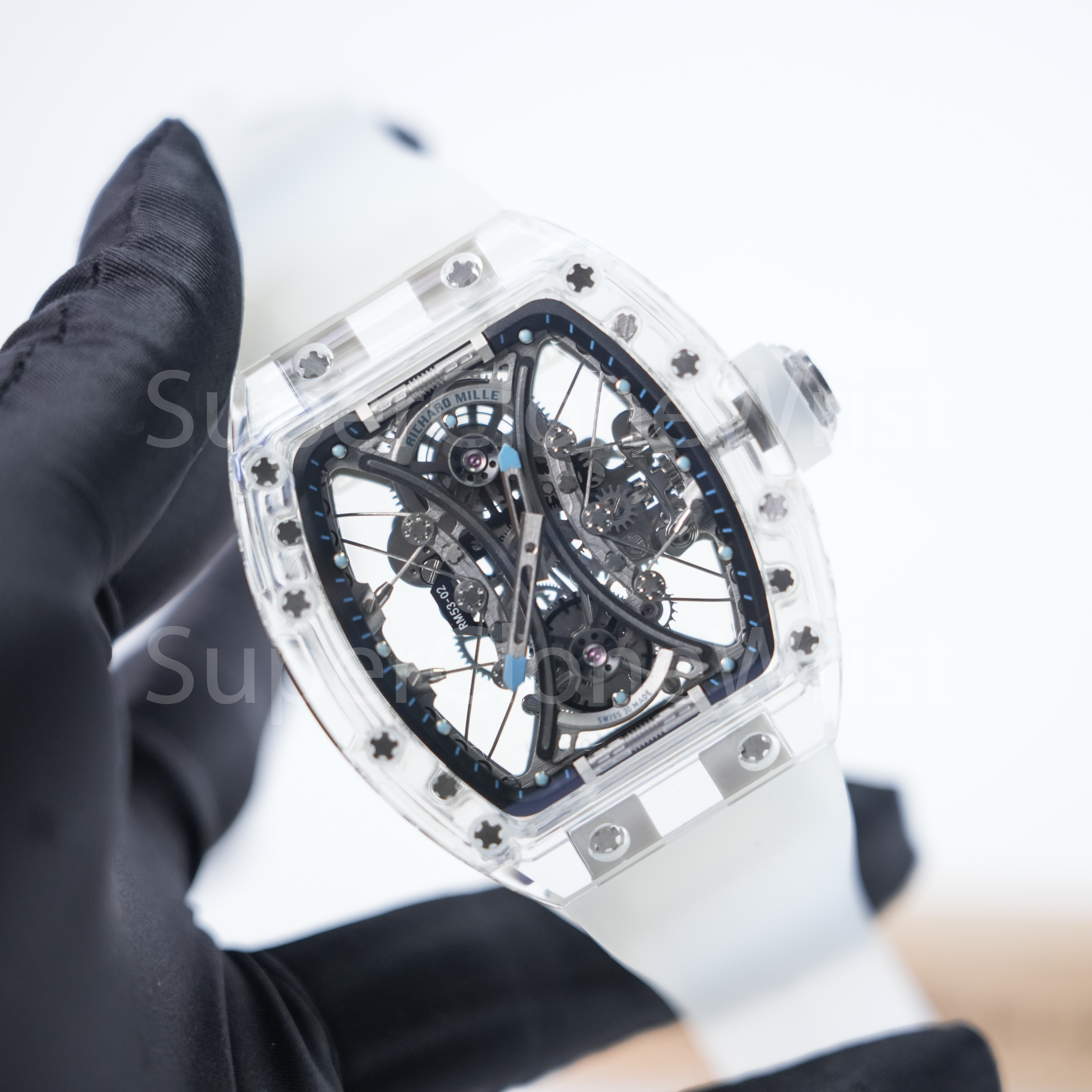
Best for maximum transparency
RM 53-02: Architecture From Every Angle
This direction places the transparent case and exposed internal structure at the centre. The angled image makes the crown, front screws, case depth and white strap transition easier to inspect.
Strongest use: an occasional statement piece paired with plain black, grey, navy or white clothing.
Main checks: transparent case edges, screw seating, internal visibility, side curvature, strap connection and neutral-light photographs.
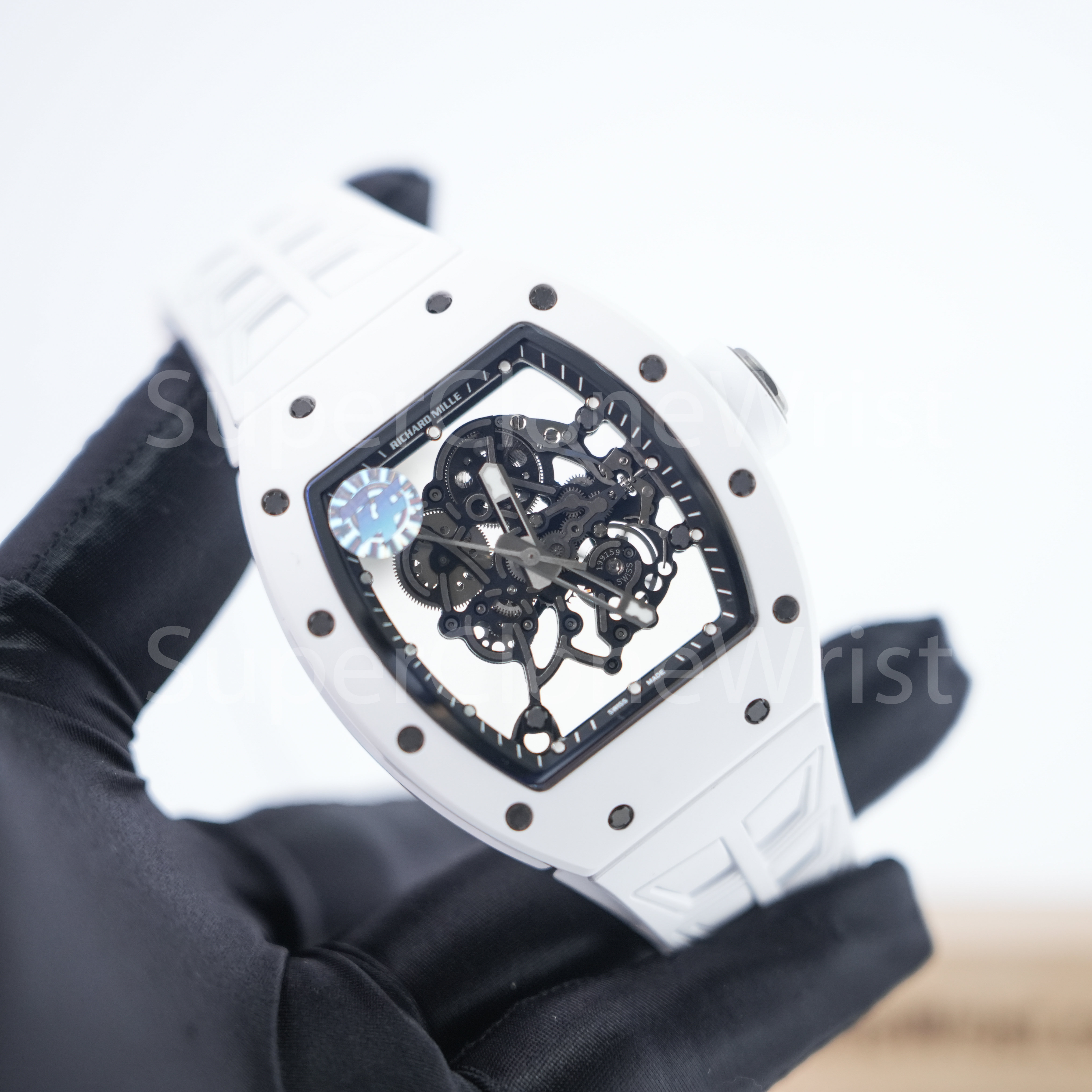
Best for strong daylight contrast
RM 055: White Case, Clear Visual Impact
This direction creates a broad, bright outline. The white case and strap make the tonneau shape easy to see, while the darker skeleton centre gives the dial enough contrast.
Strongest use: warm-weather clothing, navy polos, pale grey layers, white sneakers and clean monochrome outfits.
Main checks: white-surface condition, bezel symmetry, screw spacing, dial contrast, strap cleanliness and case corners.
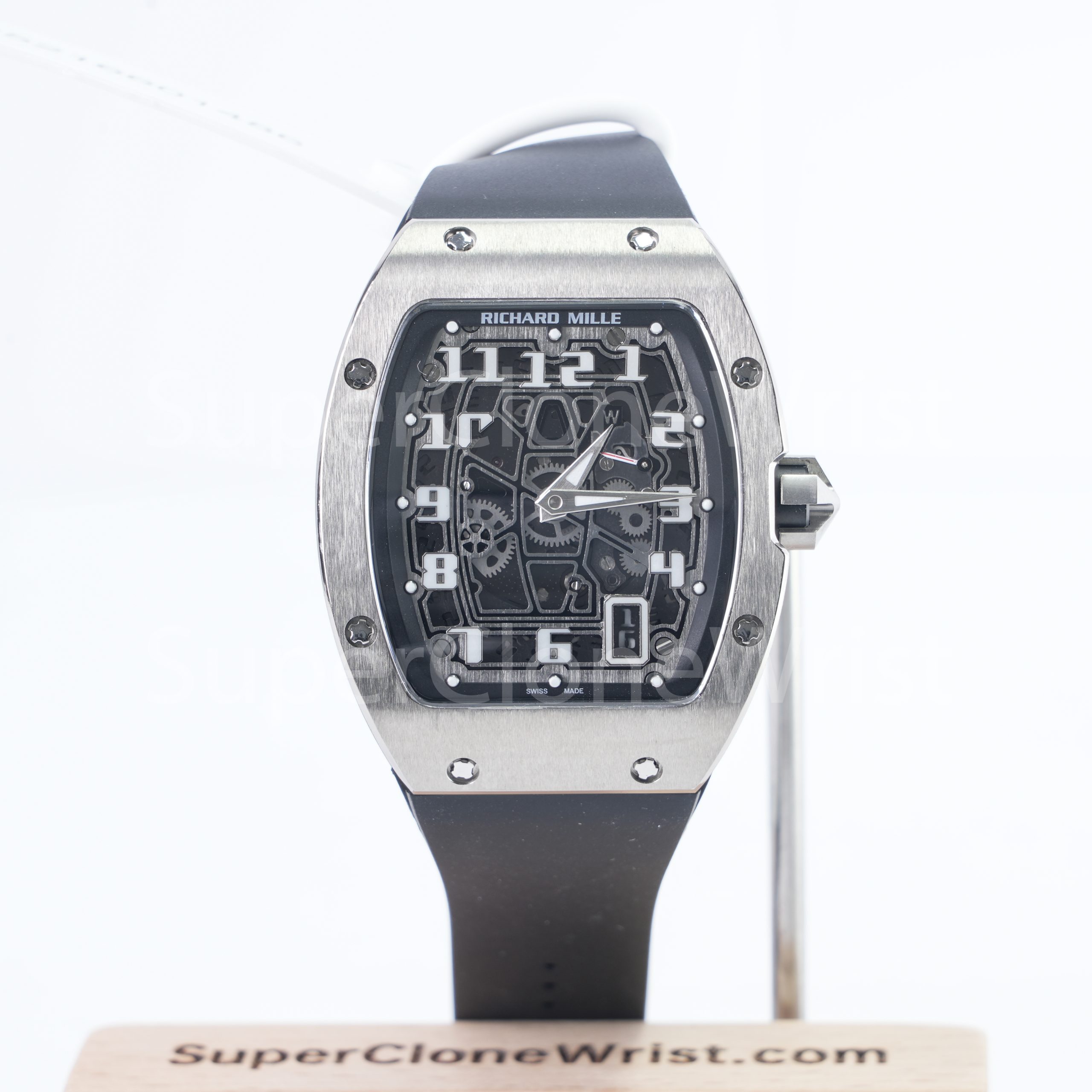
Best for a quieter technical profile
RM 67-01: A More Restrained Direction
This direction keeps the tonneau shape and skeleton structure but reduces the broad visual effect. The dark strap and controlled case outline work more naturally beside understated clothing.
Strongest use: dark denim, charcoal trousers, black knitwear, white shirts and lightweight evening jackets.
Main checks: dial legibility, case thickness, strap curve, clasp position and movement-view consistency.
Browse the Full Richard Mille Collection
Compare additional tonneau shapes, skeleton layouts, case colours and strap combinations. A practical shortlist should contain two or three clearly different directions rather than several nearly identical references.
Tonneau Case, Screws and Thickness QC
The front screws create a visible rhythm around the case. Even without measuring anything, the eye notices when one sits at a different depth, distance or position. On a clean tonneau bezel, that small interruption can become the first detail noticed in every wrist photograph.
For superclonewrist richard mille watches, screw review should remain practical rather than obsessive. The useful checks are spacing, seating depth, surrounding surface condition and overall consistency. Microscopic comparison adds little when the broader case shape or strap fit remains unresolved.
Check the Full Pattern Before One Screw
One screw can look perfect while the full bezel still feels uneven. The eye reads the group as a border around the dial. Consequently, a balanced pattern matters more than one impressive macro photograph.
Start at 12 o’clock and move clockwise. Compare the distance from each screw to the nearest case edge, then compare the open spaces between the screws and the chapter ring. This review usually takes less than a minute.
Seating depth should also look consistent. A screw should not appear to float above the bezel or sink into a rough opening. However, bright reflections can create false depth, so several screws should be compared under the same lighting angle.
Surface condition matters around each opening. Tool marks, chipped edges or rough material can draw attention whenever the case catches sunlight. A useful close-up should show the screw and several millimetres of the surrounding surface.
Case Layers Need Clean Separation
Many tonneau cases use visible layers: bezel, middle case and caseback. That construction creates depth from the side, although it also exposes uneven gaps. The space between layers should follow the case curve without sudden widening near a corner.
At a café table, this layered side view remains visible while the dial points away. A clean separation makes the watch feel engineered. An inconsistent gap, by contrast, can make the case look assembled from unrelated pieces.
Colour transitions need the same control. A white bezel over a darker middle section creates a strong line, so irregular spacing appears quickly. Dark-on-dark construction hides small changes better, although a bright side photograph can still expose them.
Crown position affects the side balance as well. The crown, case curve and nearby guards should feel like one structure. During a natural bend of the hand, the crown should not appear to sit unusually high or press sharply toward the back of the hand.
Thickness Must Be Judged as a Complete Stack
One thickness number cannot explain where the height sits. Some cases concentrate depth in the crystal and bezel. Others use a taller caseback, which raises the watch even when the visible sidewall looks relatively slim.
Therefore, the complete stack matters: crystal, bezel, middle case and caseback. A well-distributed profile can look deliberate at a substantial height. A poorly distributed profile can feel awkward at a smaller number because one section dominates.
Sleeve clearance provides a useful real-world test. A broad case with a high crystal may catch a narrow cuff every time the hand reaches for a phone. In that situation, the watch works better as a visible outside-the-cuff piece rather than a discreet office option.
The site’s QC Process explains how dial, case, strap, clasp and visible movement details can be reviewed in a consistent order. Visual material can support a condition check, but it cannot promise water resistance, customs outcomes or long-term mechanical performance.
A front dial image is not enough.
A complete case review should show both sides, the caseback, the crown, the strap connection and the watch on a wrist. Without those views, real thickness and curvature remain unclear.
Rubber Strap and Wrist Presence
A rubber strap changes how a large case behaves. It removes the visual weight of a full metal bracelet and gives the watch a more athletic outline. However, comfort depends on shape, length and flexibility rather than the material name alone.
With superclonewrist richard mille watches, strap integration deserves close attention because the case and strap form one continuous design. A visible gap near the attachment point interrupts that flow. Likewise, a strap that bends too late can make the case appear wider than expected.
The First Two Centimetres Matter Most
The strap section nearest the case controls the initial curve. When those first two centimetres remain stiff, the strap projects outward before wrapping downward. That shape can leave space at both sides of a smaller or rounder wrist.
A top-down wrist image may hide this space. Therefore, a low side angle provides more information. It should show whether the strap touches the wrist soon after leaving the case or creates an arch above it.
Warm weather can make the difference more noticeable. After a twenty-minute walk, a close strap may feel secure but less ventilated. A looser setting allows airflow, although a heavy case may shift during faster movement.
Strap thickness should also match the case. A narrow or thin strap beneath a tall case can make the design look disconnected. A stronger strap profile creates a smoother visual transition and usually supports the case more evenly.
Clasp Position Can Change the Wearing Experience
A folding clasp works best when it sits near the centre beneath the wrist. When one strap side is too long, the clasp can rotate toward the edge and pull the case off-centre. That imbalance becomes tiring during a long desk session.
A useful photograph shows the underside of the wrist while the watch is closed. That view explains where the clasp lands and whether one strap side carries most of the tension. A top image cannot answer either question.
The clasp also adds thickness beneath the wrist. This matters while typing because the metal section rests against a desk. A close image can show its width, edge shape and how cleanly the folding sections meet.
Wrist circumference and preferred fit should be included in the official support message. Any need for alternative strap lengths should be stated directly. Product photographs rarely explain how much adjustment remains.
White, Black and Coloured Straps Serve Different Roles
A black strap keeps the case visually contained. It works with dark denim, grey trousers, plain T-shirts and most travel clothing. Because the strap does not demand much attention, the skeleton dial stays central.
A white strap creates a brighter and broader outline. It suits summer clothing, white sneakers, navy polos and light technical jackets. Still, every mark appears quickly, so current photographs should show the strap surface and case corners clearly.
A coloured strap can refresh a familiar case without changing the watch itself. Blue works naturally with neutral clothing and denim. Red or orange feels more occasional, particularly when the dial already contains several coloured accents.
Matching strap and case colours creates one unified block. By contrast, a contrasting strap separates the case and can reduce its apparent size. That difference becomes clear in a full-arm image rather than a tightly cropped wrist shot.
| Scene | Stronger Direction | Main Check |
|---|---|---|
| Weekday smart casual | Dark, slimmer tonneau profile | Cuff clearance and case height |
| Warm-weather weekend | White case or visible strap colour | Strap comfort and surface condition |
| Dinner or event | Detailed skeleton dial with restrained colour | Dial depth under indoor light |
| Occasional collection piece | Transparent case or unusual finish | Version, QC evidence and realistic wearing frequency |
Related Bold Watches to Browse
Richard Mille should remain the main route when a curved tonneau case and exposed mechanical architecture define the search. Still, one related sports-watch collection can clarify whether the real priority is tonneau curvature or a broader round case with a rubber strap.
The Hublot Super Clone Watches collection provides that contrast. Its role here is limited: it shows how an exposed-screw bezel and rubber-strap format can create strong wrist presence without using the Richard Mille tonneau silhouette.
The distinction becomes clear quickly. A broad round case feels more conventional from the front, while a tonneau case remains unusual from every angle. When the curved rectangular silhouette is the central attraction, the Richard Mille collection remains the stronger direction.
A Practical Richard Mille Selection Path
A long product grid can make every model look equally interesting. After fifteen open tabs, however, the differences begin to blur. A better approach reduces the field to three visual roles, then checks case shape and strap fit before movement decoration.
Start with the intended wearing scene. A dark weekday piece, a bright weekend piece and a transparent collection piece serve different purposes. Once the role is clear, colour and case finish become easier to evaluate.
Build a Three-Model Shortlist
The first model should be the safest choice. Usually, that means a dark strap, controlled case colour and readable skeleton dial. It should work with at least three existing outfits without requiring new clothing.
The second model should test a stronger direction. A white case, transparent case or brighter accent reveals how much wrist presence feels comfortable. The third model can explore a slimmer or more restrained shape.
This structure prevents duplicate choices. Three black skeleton models with small detail changes do not create a useful comparison. Three distinct roles expose the real preference much faster.
Compare the Current Version at Model Level
Factory names alone do not explain a watch. One version may handle a particular case well, while another model associated with the same source may need different checks. Therefore, version discussion should always include the exact product link and reference.
The Factory Version Guide provides the broader framework. For a Richard Mille-style selection, the practical questions concern case proportions, visible movement layout, strap attachment, available movement configuration and reviewable QC evidence.
Current information should replace old screenshots. A factory label from several months ago may not describe the present version or available configuration. Consequently, final confirmation should happen after the shortlist is ready, not at the beginning of the search.
Use One Complete Support Message
A clear message saves several rounds of scattered questions. It should contain the product link, model name, preferred case and strap colour, wrist circumference, current-version question and requested QC angles. Destination and payment questions can remain in the same official thread.
For example, a useful message can request a straight dial image, both case sides, caseback, clasp, strap attachment and a short wrist video when available. It can also ask which visible functions can be shown before dispatch.
That message should avoid assumptions. It should not state that the watch is waterproof, that a particular movement is guaranteed or that delivery will follow an old timeline. Current details belong in the Official Contact thread.
Message template
“This product link is under consideration. Please confirm the current factory version, available movement configuration, case and strap option, wrist-size suitability, QC photo or video availability, current payment instruction and delivery support for the destination. A straight dial image, both side profiles, caseback, clasp and strap connection would be useful when available.”
Review QC in a Fixed Order
Begin with the case outline before zooming into the movement. This takes discipline because the skeleton dial is more entertaining. Still, a strong dial cannot correct a flat case, awkward strap angle or excessive wrist height.
Next, check dial depth, hand contrast and chapter-ring alignment. Then inspect screws, case layers, crown position and visible surface condition. Finish with the strap, clasp and wrist-scale image.
A final video should answer one or two specific questions. A long general video often creates more footage without more information. A slow side rotation or clasp demonstration usually proves more useful than fast movement under strong light.
The How to Buy from SuperCloneWrist guide continues this process from product selection through version questions, QC preparation and official confirmation.
Related Reading
QC Process
Review dial, case, strap, clasp and visible movement evidence in a consistent order before dispatch.
Factory Version Guide
Compare current versions by the exact model, visible construction, movement configuration and available QC evidence.
How to Buy from SuperCloneWrist
Follow the route from one selected product link to version checks, QC requests and final confirmation.
Frequently Asked Questions
What should be checked first on a Richard Mille-style watch?
Start with the complete case silhouette. A straight front image should show symmetry and bezel width, while a side image should show curvature, thickness, caseback height and strap exit. The skeleton dial comes after the case because a detailed dial cannot correct an awkward profile.
How can skeleton dial depth be judged from photographs?
Use at least one angled image under neutral light. Raised hands, markers and bridges should cast separate shadows as the angle changes. A slow rotation video helps because different layers should catch light at different moments.
Can a larger tonneau case work on a smaller wrist?
It can work when the case curves strongly and the strap turns downward near the attachment point. Wrist shape matters beside circumference, so a side wrist image gives better guidance than a size number alone. Clasp position should also be confirmed.
Which QC images are most useful for superclonewrist richard mille watches?
A useful set includes a straight dial image, crown-side profile, opposite-side profile, caseback, strap attachment, clasp and wrist-scale image. When available, a short video can show case rotation, clasp action and visible functions.
Should a factory name decide the model?
No. The exact model should lead the comparison because case construction, skeleton layout and strap design vary widely. A factory name becomes useful only when it connects to a current model, movement configuration and reviewable QC evidence.
Is a white Richard Mille-style watch practical for regular use?
A white case and strap can work well in a warm-weather rotation. The bright outline pairs naturally with navy, pale grey, stone and white clothing. However, surface marks and strap condition become visible quickly, so neutral-light photographs matter.
Can QC photos guarantee long-term performance?
No. QC photos help review visible condition, alignment, case shape, strap connection and surface finish before dispatch. They do not guarantee water resistance, customs outcomes, future accuracy or long-term mechanical operation.
Where should availability and payment details be confirmed?
Current availability, factory version, movement configuration, QC timing, payment information and delivery support should be confirmed through the official contact page. Old screenshots and copied messages may no longer reflect current details.
Final Selection Advice
A Richard Mille-style watch succeeds when the case, dial and strap feel designed as one object. The skeleton movement appearance may create the first reaction, yet the curved side profile determines whether the watch still looks right during a full afternoon.
The strongest shortlist normally contains one dark versatile model, one brighter statement model and one transparent or technically unusual model. That group reveals a real preference without opening twenty nearly identical product pages.
- Save no more than three product links, each with a different visual role.
- Request front, side, caseback, strap and wrist-scale evidence when available.
- Confirm the current version, movement configuration, QC process, payment information and delivery support through the official page.
For superclonewrist richard mille watches, a careful five-minute side-profile review often adds more value than another hour comparing dial colours. The stronger direction should look coherent from across a room, remain balanced beside ordinary clothing and still reward a closer look at the skeleton architecture.
Confirm before payment
Check the Model, Version, QC Route and Current Details
Send the selected product link or reference through the official channel. Ask for current factory information, movement configuration, wrist-fit guidance, available QC evidence, payment instructions and destination support before any order decision.