At 8:40 on a weekday morning, a Datejust usually has one job: look settled before the first meeting starts. SuperCloneWrist datejust watches are easier to compare when the choice stays practical: 36mm or 41mm, Jubilee or Oyster, fluted or smooth bezel, and a dial that still feels right after a full day.
This guide stays focused on Datejust selection. It covers daily wear, wrist presence, bracelet feel, dial character, Cyclops checks, QC photo review, and the exact pages that help turn research into a clear next step.
A Datejust decision is usually smaller than it looks
However, small does not mean easy. A 36mm case can look perfect in a chair photo and too quiet in a mirror. A 41mm case can look strong in a product image and too wide after a shirt cuff slides back at 2 p.m.
So, the cleanest Datejust choice starts with use, not noise. The watch should still make sense after a full day: desk light at noon, restaurant light at 7 p.m., and a quick glance beside a phone screen before leaving the house.
Why Datejust Is a Daily Wear Option
For daily wear, the Datejust sits in a useful middle lane. It is less sporty than a Submariner, less busy than a Daytona, and less formal than many full dress watches. That mix matters during a normal 10-hour day.
Also, the date window gives the watch a small practical reason to exist. On Monday morning, the 3 o’clock date is not decoration. It helps during calendar checks, invoice reviews, travel plans, and simple date checks before a meeting starts.
Meanwhile, the case shape stays familiar from a few steps away. A Datejust does not need a rotating bezel, exposed pushers, or a large crown guard to feel complete. The clean case, polished bezel area, Cyclops lens and bracelet do most of the work.
For background, Rolex’s official Datejust page presents the model as a classic date-display design and shows why the 3 o’clock date window remains central to the collection. View the official Datejust reference.
Still, restraint is important. A loud dial, fluted bezel, two-tone case and Jubilee bracelet can all look attractive alone. Together, those details may become too much under bright office lights or in a close wrist photo.
The useful Datejust is the one that stays calm
In practice, the best daily Datejust setup is rarely the loudest one in the grid. A blue dial on steel, a silver dial with a fluted bezel, or a black dial on Oyster often works across more situations than a highly decorative layout.
For example, a 9 a.m. office setting rewards clean proportions. A 7 p.m. dinner setting rewards a little shine. The Datejust is strong because it can cover both scenes without feeling like two different watches are needed.
That is why superclonewrist datejust watches should be judged from normal distance as much as close-up detail. Dial printing matters, of course. Yet the larger question is whether the whole setup looks natural beside a sleeve, a ring, a laptop and a simple jacket.
36mm vs 41mm Selection Notes
The 36mm Datejust is still the cleaner classic choice. It keeps the dial compact, shortens the visual distance between markers, and lets the bracelet carry more of the design. On many wrists, it looks more deliberate than expected.
However, the 41mm Datejust has a real place. It suits broader wrists, casual jackets, open-collar shirts, and outfits where a smaller watch may disappear. The larger dial also gives sunray colors more room to shift under light.
Here is the honest take: 41mm should not be chosen only because it sounds modern. The Datejust design was not built around size flexing. If the lugs push close to the wrist edge in a mirror photo, the watch will look wide during normal movement too.
At the same time, 36mm should not be treated as fragile or outdated. On a plain black T-shirt, a 36mm Datejust can look sharper than a larger watch. The smaller case gives the bracelet and dial a tighter, more mature rhythm.
| Choice point | 36mm Datejust | 41mm Datejust |
| Visual character | Compact, classic, neat from 1 meter away | Broader, modern, easier to notice in photos |
| Strong setting | Office cuff, dinner shirt, light knitwear | Casual jacket, travel outfit, larger wrist profile |
| Main risk | Can feel too quiet if strong wrist presence is preferred | Can look flat or wide when the dial is too open |
| Best early filter | Check whether the watch still reads clearly from arm’s length | Check whether the bracelet drops smoothly after the end link |
A wrist photo says more than a case number
When a model is compared, a straight product photo is only the first step. A wrist-style angle at 20 or 30 degrees shows whether the case looks planted or floating. That angle often decides the size question faster than another paragraph of specifications.
Also, bracelet drop matters. If the first 2 or 3 links flare outward before curving down, the watch can feel larger than the listed diameter. If the links fall cleanly, even a 41mm Datejust can look comfortable.
Therefore, size should be checked with the full watch in view. Case diameter, lug shape, dial color, bezel shine and bracelet type all change the final impression. A 36mm fluted Jubilee and a 41mm smooth Oyster do not behave like the same object scaled up.
Jubilee vs Oyster Bracelet Choices
The Jubilee bracelet is the most Datejust-looking choice. Its five-link pattern breaks light into smaller flashes, especially when a hand moves across a keyboard or reaches for a cup. On a fluted bezel model, that texture feels natural.
By contrast, the Oyster bracelet gives the Datejust a straighter, cleaner line. The three-link design feels firmer and less formal. On a 41mm smooth bezel model, Oyster can make the watch look more modern without turning it into a sports watch.
Still, the stronger Datejust identity usually sits with Jubilee. Not always, but often. The Datejust is not meant to be a hard-edged tool watch, and the Jubilee bracelet brings out the soft dress-casual side better than Oyster.
However, Oyster becomes the safer choice when the dial or bezel already has enough shine. A diamond marker dial, bright blue sunray dial, or strong two-tone case can look calmer when the bracelet stops adding extra reflections.
Bracelet choice changes the whole mood
For example, a 36mm fluted Datejust on Jubilee looks ready for a white shirt at 9 a.m. The same case idea on Oyster feels plainer and less ceremonial. Neither route is wrong, but the message is different.
Meanwhile, a 41mm Datejust with a smooth bezel and Oyster bracelet feels stronger with denim, knitwear and weekend jackets. It has less sparkle, so the case size becomes the main visual detail.
Because of that, bracelet selection should happen before dial drama. Once the bracelet tone is set, dial and bezel choices become easier. A calm bracelet can handle a stronger dial, while a shiny bracelet often needs a quieter dial.
Simple pairing rules that usually hold up
- For 36mm with fluted bezel, Jubilee gives the cleanest classic Datejust balance.
- For 41mm with smooth bezel, Oyster keeps the watch sharp and more casual.
- For two-tone cases, Jubilee softens the warm metal and makes the layout feel intentional.
- For bright or diamond-marker dials, Oyster can reduce visual noise during daytime wear.
Datejust Model Path: Start With Three Clear Directions
At this stage, opening real model pages helps more than reading another abstract size opinion. A useful comparison can start with one modern green-toned 41mm option, one clean white smooth-bezel 41mm option, and one classic rose-tone 36mm reference. This keeps superclonewrist datejust watches easy to compare without turning the page into a random product wall.
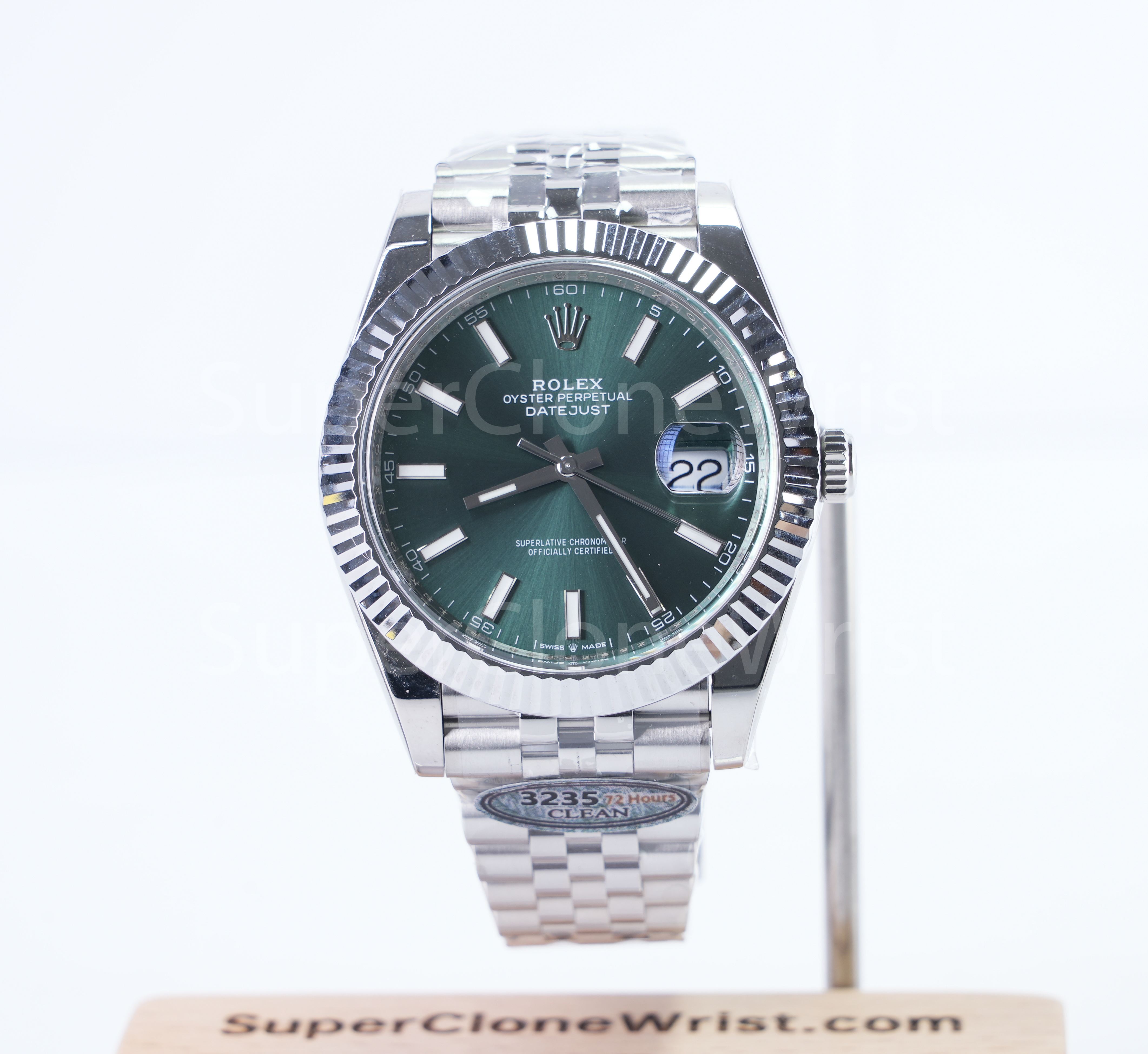
Matte Blue-Green 41mm Datejust
For a modern daily look, the blue-green dial gives the 41mm case a fresher tone while the fluted bezel keeps the Datejust identity clear.
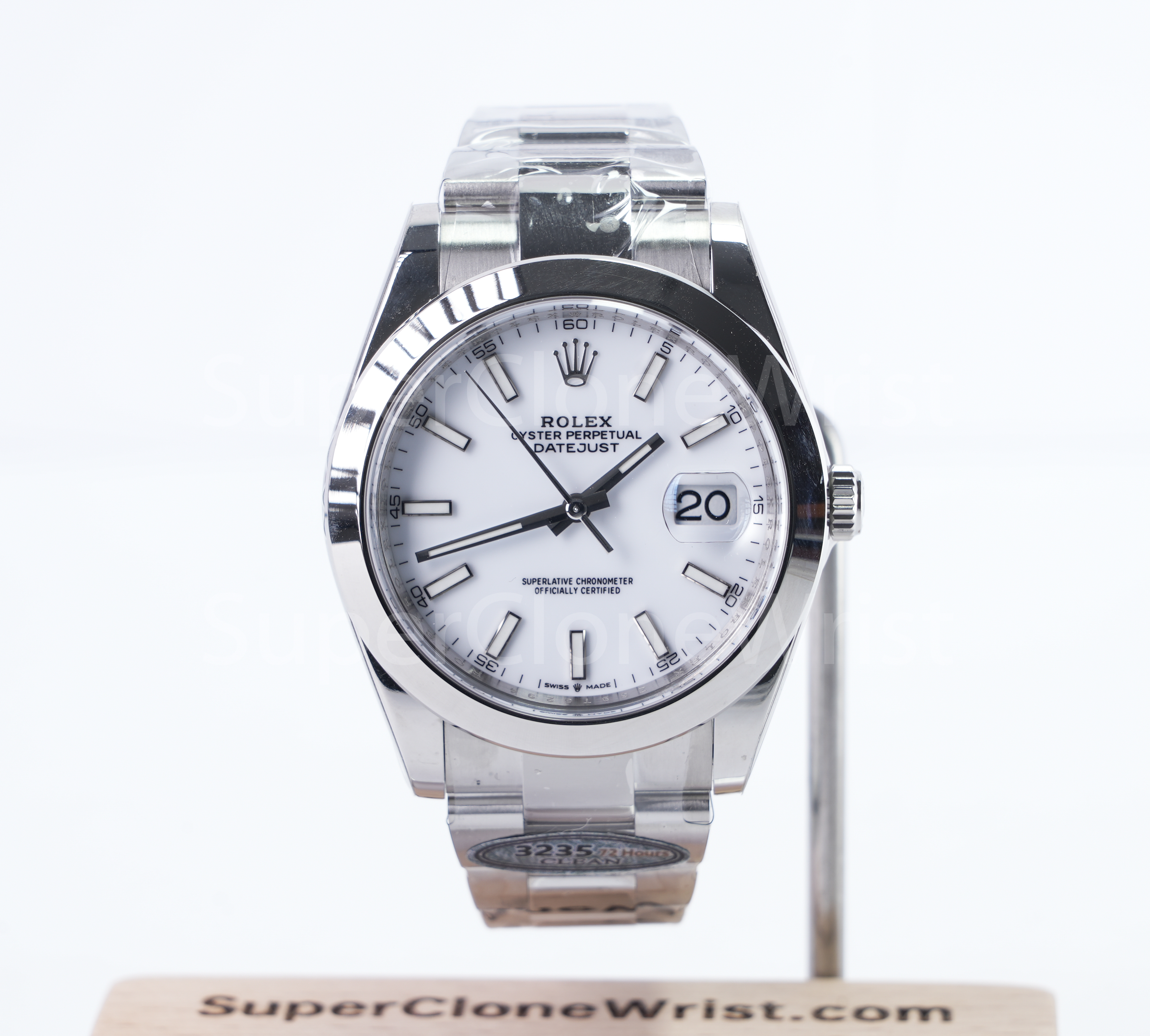
White Dial Smooth Bezel 41mm
For a cleaner weekday setup, the white dial, smooth bezel and Oyster bracelet keep the 41mm case sharp without adding extra shine.
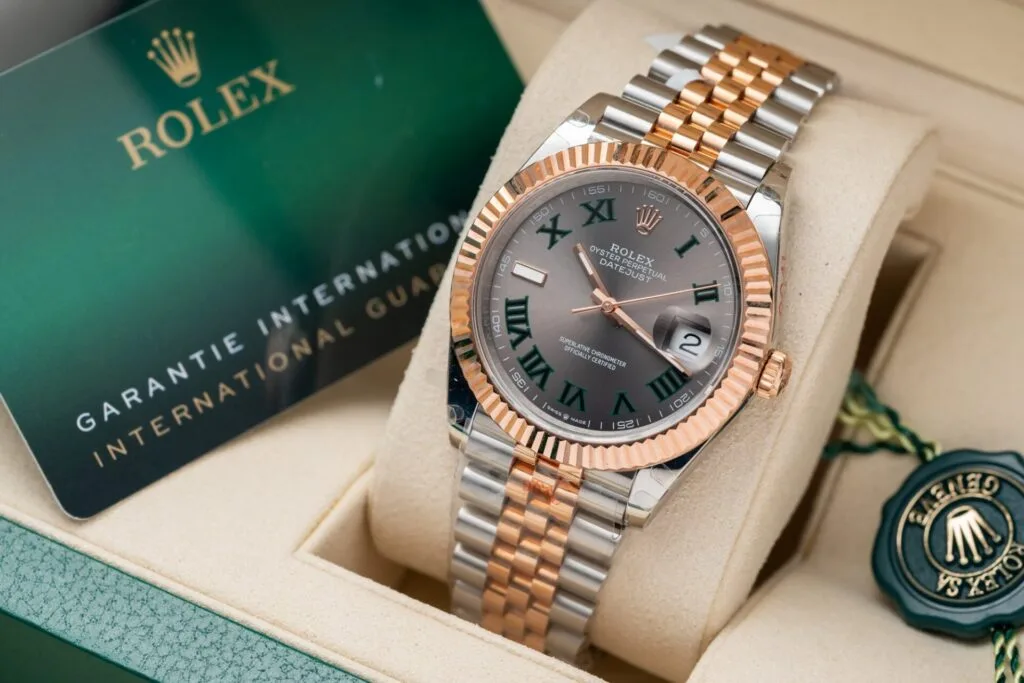
Grey Dial Rose-Tone 36mm
For compact Datejust proportion, the 36mm case, grey Roman dial and two-tone Jubilee bracelet give a warmer classic route.
Browse the Datejust category before narrowing the final reference
For a wider scan, the Datejust Super Clone Watches page is the most useful hub. It keeps 36mm, 41mm, fluted bezel, smooth bezel, Jubilee, Oyster and dial variations close together.
Also, this order keeps the search clean. Start with size, then bracelet, then bezel, then dial. The final reference should feel like a result of the comparison, not a lucky click.
Dial Choices: Blue, Black, Silver, White, Champagne and Wimbledon
Dial choice changes the Datejust in about 3 seconds. Blue feels modern. Black feels tidy. Silver feels clean and low-risk. White feels crisp and weekday-friendly. Champagne brings warmth. Grey or slate sits between dress and casual without trying too hard.
However, the dial should be judged with clothing and light in mind. A bright sunray dial can look amazing beside a window at 4 p.m. Under flat white office LEDs, the same dial may look stronger and more reflective.
Meanwhile, the Wimbledon dial has a very different personality. Roman numerals and green accents add character fast. It works best when the rest of the outfit is simple: plain shirt, dark trousers, quiet shoes, no competing pattern.
Diamond marker dials need the most caution. They can look sharp in a close product photo, but daily lighting is less polite. At a dinner table, the markers may look refined. At a small office desk, they may become the whole story.
The safest daily dial is not always the most exciting one
For 5-day wear, black, blue, white, silver, slate and champagne usually hold up best. These colors do not require a full outfit plan. They work with a navy shirt at 10 a.m., a grey hoodie on Saturday, or a light jacket after dinner.
Also, dial texture should match the case size. A 41mm sunray dial has more open area, so color shifts are easier to see. A 36mm textured dial feels tighter, which can make Roman numerals or diamond markers look more concentrated.
Therefore, a dial should be checked in at least two light angles when photos are available. One straight front photo shows alignment. One angled photo shows whether the finish looks even across the full surface.
Dial notes by scene
For office use, black, white, silver and slate dials stay controlled. They do not pull attention every time the wrist moves near a laptop. That makes them easy choices for a white shirt, navy knit, charcoal jacket or plain black polo.
For warmer styling, champagne, chocolate and rose-tone grey dials make more sense. They connect naturally with brown leather shoes, a gold ring, tortoise glasses or a beige coat. Without another warm detail, two-tone models can feel slightly isolated.
For a stronger statement, Wimbledon and diamond-marker dials work better as occasional pieces. They have more personality at first glance. Because of that, the surrounding outfit should stay quieter and cleaner.
Bezel, Cyclops and Dial QC Checks
Datejust QC is not about one secret detail. Instead, it is about reading the watch as a group of visible parts: bezel shape, crystal view, Cyclops position, date centering, dial print, marker alignment, hand stack, bracelet fit and clasp closure.
For fluted bezels, the grooves should look even around the full ring. Under direct light, the flashes should feel consistent. If one area looks flat while another looks sharp, an extra angle is useful before any final step.
For smooth bezels, the check is different. The surface should look clean, round and polished without a dull grey edge. Smooth bezels show small finishing issues quickly around 12 o’clock and 6 o’clock.
The Cyclops lens also deserves a careful look. The date should sit centered and readable in the window. If the number leans high, low or sideways, it will stand out every time the wrist turns during the day.
Dial print and marker alignment
On a blue, white, slate or champagne dial, the minute track should feel even around the full circle. At 12 o’clock, the crown marker and printed text should sit straight enough to look calm in a close photo.
Also, baton markers need consistent spacing from the minute track. One marker sitting too close to the edge can make the whole dial feel nervous, especially on a 36mm case where the surface is tighter.
Hands, crystal and date view
At 10:10, the hands frame the upper dial well, so that angle helps reveal balance. The center pinion should look clean, and the hands should not appear rough or uneven in close photos.
Meanwhile, the crystal should not create a cloudy layer over the dial. If glare hides the date or the printed text, another photo is more useful than a long description.
Use QC as a filter, not a formality
The QC Process page should be part of the decision, especially for fluted bezels and textured dials. These surfaces change quickly under light, so one perfect front photo may not show enough.
Also, factory version can affect case shape, bracelet feel, dial tone and movement option. The Factory Version Guide helps frame better questions before any payment step.
For superclonewrist datejust watches, the practical photo set is simple: front dial, side case, date window, bracelet, clasp and one wrist-style angle. Six views usually answer more than a single polished product image.
Datejust QC checklist
- Check the date number inside the Cyclops from a straight front photo.
- Check fluted bezel grooves under light, especially near 12 and 6 o’clock.
- Check dial print, crown marker, baton markers and minute track spacing.
- Check bracelet line, end-link fit, clasp closure and polished center links.
- Check one wrist-style photo to confirm real visual size before confirmation.
Which Datejust Page to Browse First
For a focused Datejust search, the collection page should come first. The Datejust Super Clone Watches page keeps the relevant choices together, so the comparison does not drift into unrelated Rolex models too early.
After that, the wider Rolex Collection can help when Datejust is being compared with Daytona, Submariner, GMT-Master II or Oyster Perpetual. That broader step works best after the Datejust size and bracelet preference are already clear.
Also, the order matters. Size comes before dial color. Bracelet comes before diamond markers. QC expectations come before payment. That order prevents one attractive detail from hiding a weaker overall fit.
Therefore, the most useful browse path is narrow first, then broad. Save 2 or 3 Datejust references, compare them by case size and bracelet, then use official contact to confirm what is current.
A cleaner route before confirmation
Send one model link, one preferred size, and one bracelet preference through Official Contact. Then confirm available version, movement option, current photos, QC steps and order details. Water exposure, customs route, long-term performance and availability should not be assumed from a blog page.
Daily Scenarios and Pairing Notes
For a workweek setup, a black, white, silver, blue or slate dial is the easiest Datejust route. It looks settled during a 10-minute presentation, yet it does not compete with a navy shirt, grey jacket or simple black belt.
For travel, a 41mm steel Datejust on Oyster feels useful because it reads slightly sportier. It works with a bomber jacket, a hoodie, or a plain white travel shirt at the airport without looking too formal.
For dinner, a fluted bezel on Jubilee gives the Datejust its familiar sparkle. Under warm restaurant lighting, the bracelet catches small highlights when a menu is opened or a glass is lifted.
For quiet weekends, the smooth bezel is underrated. It tones down the watch and makes the case look cleaner with knitwear, denim, or a plain T-shirt. On a 41mm model, smooth bezel plus Oyster may be the most relaxed Datejust setup.
Color pairing that actually helps
With dark clothing, silver, white and blue dials add contrast without feeling warm. With beige, cream or brown clothing, champagne, chocolate and rose-tone grey dials feel more connected. The metal tone should look like part of the outfit, not an afterthought.
Also, two-tone Datejust models look better when another warm detail is present. A gold ring, brown leather shoes, tortoise glasses or a warm belt buckle can make the watch feel planned in 2 seconds.
In real use, superclonewrist datejust watches are judged in ordinary scenes, not only macro photos. A good setup should look right beside a phone, a cuff, a steering wheel, a table lamp and a simple weekend jacket.
Related Reading
These related pages support the same Datejust decision path: compare the collection, understand the QC steps, then confirm factory version and contact details before any order action.
Datejust Super Clone Watches
Open the full Datejust category to compare 36mm, 41mm, Jubilee, Oyster, smooth bezel, fluted bezel and dial options in one place.
QC Process
Review how photos, video proof, dial checks, bezel checks, bracelet checks and pre-shipping review fit into the confirmation process.
Factory Version Guide
Use this guide to frame questions about factory version, movement option, bracelet finish, case profile and current model details.
Final Datejust Selection Advice
The best Datejust choice is usually the one that looks slightly calmer than expected. A 36mm Jubilee model can feel more refined than a loud 41mm setup. A smooth bezel can look better than fluted when the dial already has enough shine.
Before any order step, imagine four ordinary scenes: a morning cuff, a noon desk light, a dinner table, and a weekend jacket. If the same Datejust still feels balanced in all four places, the choice is probably close.
Also, confirmation should stay practical. Use the model page, confirm the available version, review QC photos, and keep payment or shipping details inside the official contact route.
- Choose 36mm for classic balance, or 41mm for stronger wrist presence.
- Pair Jubilee with fluted elegance, or Oyster with a cleaner casual line.
- Check front, side, bracelet, clasp, date and wrist-style QC views before confirmation.
Ready to narrow the Datejust choice?
Open the Datejust collection, save 2 or 3 references, then use official contact to confirm current version, movement option, QC process and order details. For superclonewrist datejust watches, that calm final check matters more than rushing from one good-looking photo.
FAQ
Is 36mm or 41mm better for a Datejust?
For classic Datejust balance, 36mm is usually stronger. However, 41mm works well on broader wrists, casual jackets and bolder daily outfits. A mirror photo from 1 meter away gives a clearer answer than a close wrist crop.
Is Jubilee or Oyster better on a Datejust?
Jubilee gives the Datejust its most familiar dress-casual character, especially with a fluted bezel. Oyster feels cleaner and more modern, especially on 41mm smooth-bezel models.
What should be checked in Datejust QC photos?
Check bezel finish, Cyclops position, date centering, dial text, marker alignment, hand stack, bracelet fit and clasp closure. A side angle and bracelet photo are more useful than one perfect front image.
Which Datejust dial is safest for daily wear?
Black, white, silver, blue, slate and champagne dials are the safest daily choices. They work across office, travel, dinner and weekend settings without becoming the loudest part of the outfit.
Should a fluted bezel or smooth bezel come first?
Fluted bezel fits a more classic Datejust style and works well with Jubilee. Smooth bezel feels quieter and more casual, especially with Oyster bracelet and a 41mm case.
Where should Datejust order details be confirmed?
All current model, availability, factory version, QC, payment and shipping details should be confirmed through the official contact page before payment. This article is a selection guide, not a guarantee.