A Cartier Santos can look compact in a specification list and surprisingly broad once its square case reaches the wrist. In this santos medium vs large replica comparison, the Medium is the more balanced choice for most wrists below about 17.5 cm. The Large works better on broader, flatter wrists and adds a useful date display. Those few millimeters also change cuff clearance, dial spacing, bracelet movement, and how much wrist remains visible around the case.
Quick Verdict
For wrists below roughly 17.5 cm, the Medium usually looks settled from the first bracelet link to the opposite edge of the case. It leaves enough visible wrist around the square outline and moves beneath a shirt cuff with less resistance.
The Large makes more sense when the wrist is broad, the forearm is substantial, or the date receives regular use. Its wider dial reads quickly, although the case can dominate a narrow or rounded wrist.
Medium. The Large is likely to cover too much wrist.
Medium for most wardrobes and daily routines.
Wrist shape matters more than circumference alone.
Large usually gives the more natural scale.
The clearest conclusion from a santos medium vs large replica comparison is that case width cannot be read like a round-watch measurement. A square case carries metal into all four corners, while the integrated bracelet continues the visual line beyond the case. The Medium therefore has more presence than its 35.1 mm width suggests.
The Large expands the same geometry to about 39.8 mm. That number sounds familiar beside a 40 mm round watch, yet the wrist impression is noticeably broader. On a narrow wrist, the square corners can make it feel closer to a larger modern sports watch.
| Decision Point | Santos Medium | Santos Large |
|---|---|---|
| Reference dimensions | About 41.9 × 35.1 mm | About 47.5 × 39.8 mm |
| Reference thickness | About 8.83 mm | About 9.38 mm |
| Dial layout | Cleaner, compact and visually symmetrical | More open with a practical date display |
| Wrist impression | Refined, controlled and compact | Broad, modern and more assertive |
| Cuff comfort | Excellent with fitted shirts | Better with relaxed or open cuffs |
| Strongest use case | Office, tailoring and mixed weekly wear | Casual wear, travel and broader wrists |
| Main QC concern | Case profile, dial spacing and bracelet transition | Date alignment, case height and bracelet stability |
Design, Size and Wrist Fit
The Santos shape has almost no wasted outline. A polished square bezel surrounds the dial, exposed screws create a second visual rhythm, and the bracelet begins close to the case. Each element spreads horizontally and vertically, so a small change in dimensions alters the whole silhouette.
The Medium keeps those elements close together. Roman numerals sit within a compact frame, the bezel feels proportionate to the dial, and the bracelet narrows the transition toward the wrist. Nothing appears stretched.
The Large opens the dial and separates the details. The minute track becomes easier to read, the hands gain more space, and the date introduces another focal point near six o’clock. The result feels more functional, although less visually quiet.
Why the Medium looks larger than 35.1 mm
A round watch tapers away from the eye. The Santos does not. Its corners remain visible, while the polished bezel creates a bright frame that draws attention to the full case rather than only the dial.
On a 16 cm wrist, the Medium often creates a presence closer to a round watch in the upper-30 mm range. The bracelet adds enough steel to stop the watch from feeling like a small traditional dress piece.
Why the Large can overwhelm a narrow wrist
The Large reaches about 47.5 mm from top to bottom. That longer square surface covers the wrist before the bracelet has much space to curve downward.
When the wrist is rounded, the corners can appear to float near the edges. A flat wrist distributes the case more evenly and gives the first links enough room to fall naturally.
The visible difference is larger than the numbers suggest
A difference of 4.7 mm in width sounds modest until both cases are viewed on the same wrist. The Medium leaves a narrow frame of skin around the watch, which helps the square shape remain clearly readable. The Large moves closer to the wrist edges and creates a more continuous span of steel.
Close phone photography normally favors the Large. A lens held 20 cm from the wrist enlarges the nearest object and hides the relationship between the case, hand, and forearm. A photograph taken from about one meter away gives a more useful proportion check.
A mirror image adds context. When the case becomes the first visible element and the wrist almost disappears, the size is probably too aggressive. When the case, bracelet, hand, and forearm look connected, the proportion usually works.
Two Real Santos Size Directions
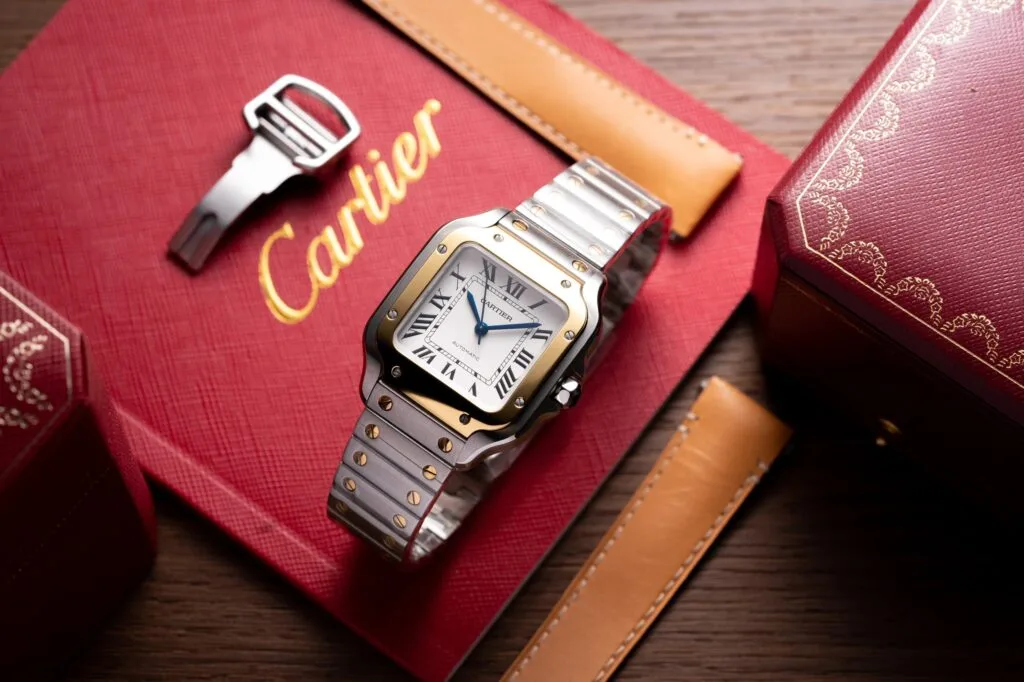
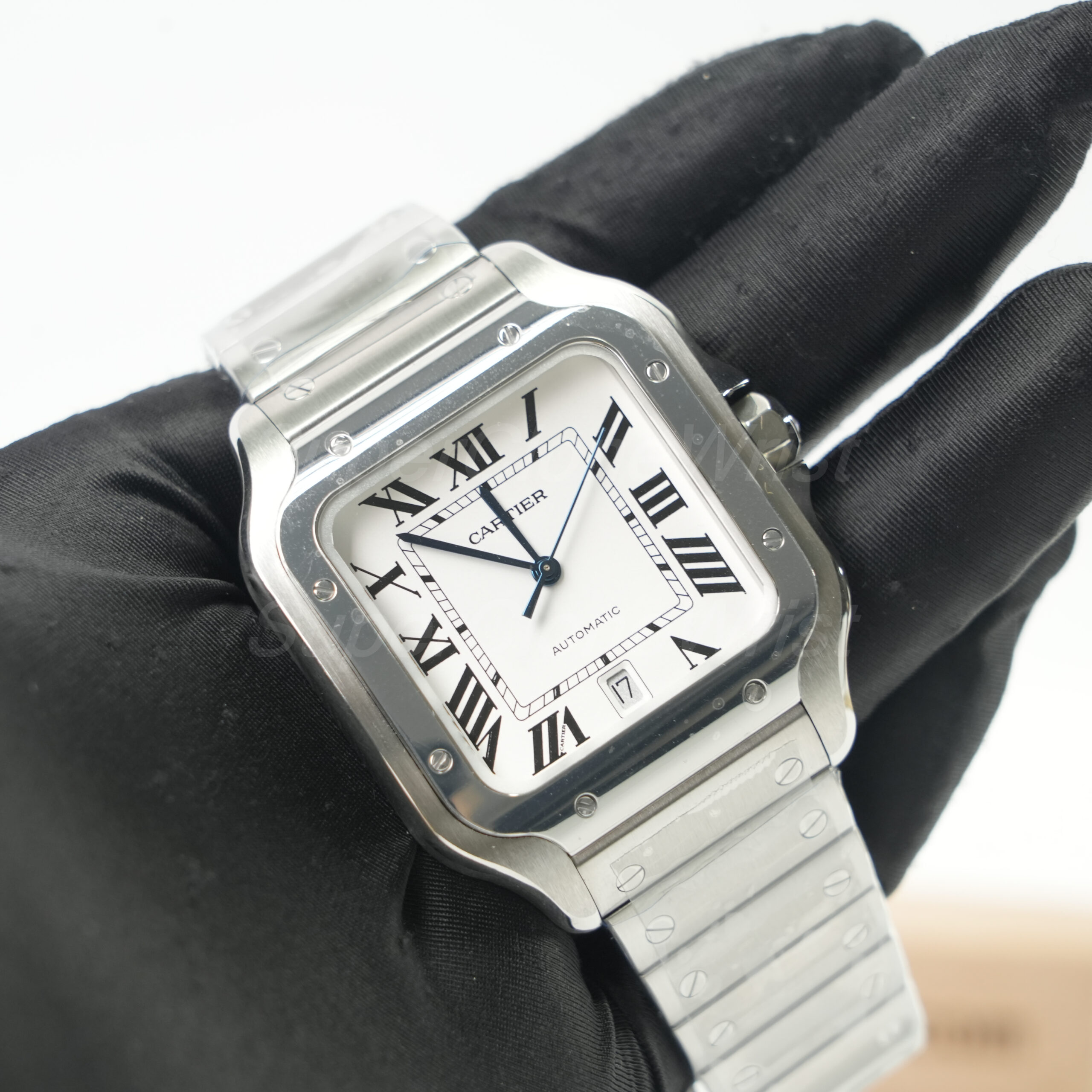
Thickness and cuff clearance
The reference thickness difference is only about half a millimeter. Still, the Large can look and feel thicker because the polished bezel covers a broader area. More reflected light makes the case appear taller, even when the side profile remains relatively slim.
The Medium normally passes beneath a fitted cuff without needing the sleeve to be adjusted. At a desk, the shorter case also stays farther from a laptop edge and wrist bone. Those small comforts become noticeable after six or eight hours.
The Large works more naturally with an open cuff, knit polo, relaxed shirt, or jacket sleeve. A narrow formal cuff may rest against the bezel, particularly when the bracelet is loose enough to let the watch move toward the hand.
Replica construction can change the result. A thick case back, tall crystal, or stiff first link can make a version feel noticeably larger than the reference dimensions imply. A true side photograph deserves the same attention as the dial.
Wrist shape matters as much as circumference
Circumference describes how much bracelet length is required. It does not show how much flat space exists beneath the case. Two wrists can both measure 17 cm and still produce opposite results with the Large.
A flat wrist may offer enough surface for the Large to sit securely, with the corners remaining inside the natural wrist line. A rounded wrist with the same circumference may provide less usable top width, which raises the case and opens small gaps near the corners.
Top width can be checked with a ruler placed across the wrist just behind the wrist bone. The ruler should rest lightly without pressing into the skin. Repeating the measurement prevents a small positioning error from deciding the size.
The Medium is the clear fit. The Large is likely to dominate both case width and bracelet curve.
The Medium keeps visible wrist around the case and remains comfortable during long desk hours.
Both sizes can work. A flat wrist supports the Large, while tailoring and rounded wrists favor the Medium.
The Large usually restores visual balance. The Medium becomes an intentionally restrained choice.
Bracelet fit changes the size impression
The integrated bracelet does more than hold the watch. It continues the case line and contributes to the total wrist footprint. A correctly adjusted bracelet lets the first links fall quickly around the wrist, keeping the square case stable.
A loose Medium can slide toward the wrist bone and lose the tidy effect that makes the size appealing. A loose Large moves even more noticeably because the broader case carries extra leverage during walking, driving, or typing.
The bracelet should not leave deep marks after an hour. At the same time, enough control is needed to stop the case from rotating outward. Warm weather can expand the wrist during the afternoon, so a cool-room adjustment should leave a small allowance.
A useful bracelet video shows the watch lying flat, hanging naturally, bending through the first links, and closing at the clasp. Those movements reveal stiffness, uneven articulation, and whether the case pulls the bracelet downward too aggressively.
Daily Wear, Styling and Collection Use
The Medium has the practical advantage during long daily wear. Its shorter case stays away from the wrist bone, the bracelet carries less visual mass, and the polished bezel is less likely to catch a fitted cuff.
At a desk, those differences become clearer after several hours. The Medium does not press against a laptop edge as often, and the case remains stable when the bracelet is adjusted closely. The watch can be noticed without being constantly felt.
The Large remains comfortable on a broad wrist. Its relatively slim case prevents it from behaving like a thick diver or chronograph. However, the wider surface and longer case create more leverage when the bracelet is loose.
Office and business wear
The Medium works naturally with a fitted shirt, navy suit, gray trousers, or knit polo. The square bezel adds structure without turning the wrist into the main feature of the outfit.
Travel and active days
The Large offers easier reading and a date during hotel check-in, airport transfers, and appointment-heavy days. The Medium feels quieter and passes beneath layered clothing more easily.
Weekend clothing
The Large pairs well with denim, overshirts, suede, short sleeves, and heavier knitwear. The Medium creates a sharper contrast with a plain T-shirt and relaxed trousers.
Medium styling: refined without feeling fragile
The Medium suits clothing with clean lines. A white shirt, dark trousers, and simple leather shoes leave enough visual space for the polished bezel and Roman numerals. The watch finishes the outfit without competing with it.
Smart-casual combinations work just as well. A light knit polo, straight denim, and a relaxed jacket support the steel bracelet. The exposed screws prevent the watch from reading like a traditional formal piece.
On a leather strap, the Medium moves further toward dress-watch territory. Black leather sharpens the white dial, while dark brown softens the steel case. A lighter tan strap feels more casual but also makes the square outline more obvious.
Jewelry should remain controlled. A slim ring or understated chain works beside the watch. Several thick bracelets can compete with the Santos screws and make the wrist look crowded.
Large styling: stronger with texture and open space
The Large handles heavier materials better. A suede jacket, dense knit, leather outerwear, or relaxed blazer gives the broader case enough visual support. The steel bracelet also looks more intentional beside a substantial hand and forearm.
Short sleeves reveal the full transition from case to bracelet, which is where the Large often looks best. The uninterrupted steel line feels modern and architectural rather than dressy.
With formal clothing, cuff width becomes important. A relaxed cuff can sit behind the case without bunching. A narrow fitted cuff may catch on the bezel or remain parked above the watch.
A leather strap makes the Large appear wider because the bracelet no longer continues the case shape. That effect works on a broad wrist, but it can exaggerate the size on a narrow wrist.
Daily wear or collection choice?
For a first Santos-style watch, the Medium is the more dependable route on most wrists below 18 cm. It captures the design without making the square case difficult to style, and its compact layout creates fewer visual distractions.
A collection already filled with 40–42 mm divers, chronographs, and round sports watches benefits from the Medium even more. Its smaller square case adds a different wrist experience instead of repeating the same size in another design.
The Large fits a collection that lacks a broad integrated-bracelet watch. It also makes sense when smaller dress watches are already available and the Santos needs to occupy a more casual, functional role.
The date can settle the decision. When it is checked several times each week, the Large gains practical value. When the watch will rotate occasionally and stop between wears, the cleaner Medium layout may remain more satisfying.
Function and operation differences
The Medium keeps operation visually simple. Fewer dial elements mean fewer alignment points to inspect, while the Roman numeral arrangement remains the center of attention.
The Large places the date at six o’clock. This position preserves the vertical center of the dial better than a date at three, but the lower Roman numeral area is still interrupted. A well-centered date looks useful and controlled; a high or low number becomes noticeable quickly.
Date change should be tested gently through the crown. A short video can show the setting position, the way the number moves, and whether the crown returns neatly against the case. The purpose is to confirm visible operation rather than treat a brief clip as proof of long-term performance.
Who should choose each size?
Choose the Medium when cuff comfort, clean dial balance, restrained proportions, and broad wardrobe compatibility matter most. It is the clear recommendation below about 17.5 cm and remains credible on larger wrists when a compact look is intentional.
Choose the Large when the wrist is broad and flat, the date receives regular use, or the rest of the watch rotation already favors substantial sports-watch proportions. Above about 18 cm, its wider bracelet and longer case normally look more naturally scaled.
Within the santos medium vs large replica choice, the Medium wins daily versatility. The Large wins visual impact and calendar convenience. Those are separate priorities rather than equal versions of the same answer.
QC, Version Choice and Delivery Checks
A version name can narrow the options, but it should not replace inspection of the prepared watch. Production batches may differ in dial printing, date placement, case height, bracelet movement, or movement setup. The individual piece shown in current QC material matters more than a familiar label.
A useful santos medium vs large replica review needs the same basic evidence for both sizes: a straight dial image, both side profiles, crown detail, case back, bracelet, clasp, and a short operating video. Measured photos become especially helpful near the 17.5–18 cm crossover range.
Medium QC priorities
- Even square case shape and consistent bezel spacing
- Crisp Roman numerals and a centered minute track
- Correct hand length and a clean central pinion area
- Controlled side profile without a bulky case back
- Smooth transition from case into the first bracelet links
- Cleanly seated bezel screws without damaged recesses
Large QC priorities
- Centered date number with balanced space in the aperture
- Consistent date font across more than one number
- Reasonable case height shown from a true side angle
- Stable case position when the bracelet is closed
- Even brushing across the broader bracelet surfaces
- Controlled crown seating and cabochon appearance
What a front photo can prove
A straight front image can show dial centering, numeral printing, hand position, bezel spacing, screw seating, and date alignment. The camera should sit directly above the dial because a tilted angle can create false asymmetry.
One dark screw does not automatically indicate a problem. Polished surfaces reflect the phone, room, and clothing. A second image under softer light often shows whether the difference is a reflection or a physical mark.
Extreme macro images can make dust or ordinary reflections appear more serious than they will look during wear. A full-watch image at normal scale should remain the main reference, followed by close images for specific concerns.
Why a side profile matters
A side photograph shows the relationship between the crystal, bezel, mid-case, case back, crown, and bracelet. That view reveals whether the case looks slim and controlled or tall and block-like.
The Large needs particular attention here. Its broad upper surface already creates visual mass. A thick case back or high crystal can make the watch feel much larger than the listed width suggests.
The first links should also appear in the frame. A flexible link that drops soon after the case improves the fit on a smaller wrist. A stiff link that extends outward adds effective length and can change the size recommendation.
Dial details on the Medium
The Medium has fewer dial elements, yet its compact layout leaves little room for visual error. Roman numerals should remain crisp rather than thick or crowded, and the railway-style minute track should look evenly placed inside the square opening.
Hand length matters. The minute hand should reach the outer track cleanly, while the hour hand should remain proportionate to the center of the dial. On a square dial, incorrect hand length becomes easier to notice near the corners.
Blue-style hands can appear bright blue in one angle and almost black in another. A slow video under neutral light provides a better judgment than one dark still photograph.
Date details on the Large
The date should sit near the center of the aperture with similar space above and below the number. A photograph showing only the numeral “1” is less useful because narrow numbers can hide horizontal centering issues.
When available, images of two different date numbers provide a better comparison. A double-digit number reveals font width, spacing, and whether the date wheel sits consistently within the opening.
A short operating clip can show crown position, hand setting, and date movement. The action should remain gentle. There is no need to force the date through the changeover period simply to create a demonstration.
Bracelet, clasp and surface finishing
The Santos bracelet contains many visible edges. Brushing should follow a consistent direction, polished boundaries should remain defined, and the first links should connect evenly to the case.
A clasp video should show opening, closure, and the final resting position. The clasp needs to sit straight when fastened. A phone recording cannot prove long-term durability, but it can reveal an obvious alignment or closure problem.
The polished bezel will show fine marks more easily than a fully brushed surface. That is part of the design rather than a size-specific fault. Deep scratches before dispatch are different and should be clarified through another photo.
How to evaluate a version recommendation
A useful recommendation connects a version to visible and practical priorities. For the Medium, those priorities are compact case proportions, controlled thickness, clean printing, and a bracelet that curves quickly around the wrist.
For the Large, date execution deserves equal weight with the case. A lower-priced option loses value when the number sits too high, the font looks inconsistent, or the aperture appears poorly placed.
Movement choice should follow the required functions and realistic servicing considerations. Decorative claims hidden behind a closed case back should not outweigh a better case profile, dial, crown, bracelet, or date display.
Current photos should match the exact dial, case material, bracelet, and size being discussed. Category images explain the model family. They do not prove the condition or details of a prepared watch.
Packaging and shipping questions
Packaging should match the intended use. A presentation box may matter for storage or gifting, while protected watch-only packaging may be more practical when the watch itself is the priority. Product images should not be treated as confirmation that every accessory is included.
Shipping details should cover the destination country, available route, tracking process, dispatch stage, and the expected parcel contents. Delivery timing can vary with route, carrier processing, customs handling, and local transfer.
The current shipping and delivery guide explains the normal route from dispatch to local delivery. A tracking pause during warehouse handoff, airline processing, customs review, or carrier transfer does not automatically mean that movement has stopped.
Keeping the model link, preferred size, destination, QC request, and packaging question in one message reduces confusion. It also creates a clear record before the order moves to dispatch.
Arrival inspection before removing protective film
Compare the dial, date, bezel, case sides, bracelet, clasp, and visible stickers with the approved images.
Inspect the crystal, polished bezel, crown, bracelet edges, and clasp before film is removed or links are resized.
Confirm crown positions, hand setting, date setting on the Large, clasp closure, and normal bracelet movement.
Clear photos and one short video create a better record than a long description written after protective material has been removed.
The SuperCloneWrist QC process provides a practical reference for checking the dial, hands, case, bracelet, clasp, crystal, and visible functions before dispatch. Photos can confirm visible condition, but they cannot confirm pressure resistance or long-term movement performance.
Final Buying Advice
The Medium is the recommendation for most wrists
Below about 17.5 cm, the Medium gives the Santos its most coherent form. The case leaves visible space around the wrist, the bracelet drops more naturally, and the compact dial keeps the design controlled.
Between roughly 17.5 and 18 cm, wrist shape decides the result. A broad, flat wrist can support the Large without obvious overhang. A rounded wrist or frequent shirt-cuff use still favors the Medium.
Above about 18 cm, the Large normally restores the correct visual scale. Its date and open dial support regular daily wear, while the wider bracelet connects more convincingly with a broad hand or forearm.
The position is clear rather than neutral: the Medium is the better all-round Santos. The Large is the better specialist choice for substantial wrists, regular date use, or a deliberately modern sports-watch look.
Record wrist circumference and top wrist width in millimeters.
Use matching wrist shots taken with a standard phone lens from about one meter away.
Review case measurements, side profile, bracelet video, dial details, and date alignment where applicable.
Related Reading
Santos vs Tank Replica
Compare two Cartier-style shapes through case geometry, formality, wrist presence, strap choice, and daily versatility.
Santos vs Datejust Replica
See how a square integrated-bracelet watch differs from a classic round daily watch in fit, styling, and flexibility.
QC Process Guide
Review the dial, case, bracelet, clasp, crown, visible functions, and supporting images before dispatch.
Frequently Asked Questions
Does the Santos Medium wear like a 35 mm round watch?
No. The square corners, polished bezel, and integrated first links occupy more visible wrist area than a simple 35 mm round case. On many wrists, its presence feels closer to a round watch in the upper-30 mm range.
Is the Large too big for a 17 cm wrist?
It often looks large, but wrist shape changes the result. A flat 17 cm wrist may support it, while a rounded wrist can make the corners and first links appear too wide. The Medium remains the safer recommendation at that circumference.
Which size is more comfortable for office wear?
The Medium normally works better at a desk and beneath a fitted cuff. Its shorter case stays farther from the wrist bone and laptop edge, while the compact outline suits business clothing more naturally.
Which model includes a date display?
The standard Large white-dial direction places a date window at six o’clock. Medium configurations should be checked by exact reference because dial and function details can differ between product versions.
What measurements should be requested during QC?
Useful measurements include case width, total case length, thickness, bracelet width, and weight where available. A ruler or caliper should appear clearly in the same image so the measurement can be understood directly.
Should weight decide between Medium and Large?
Weight can help explain wrist feel, but distribution matters more than the number alone. A broad case on a loose bracelet can feel less stable than a slightly heavier watch fitted closely to a flat wrist.
Can QC photos confirm water resistance?
No. Photographs can show visible construction and condition, but they cannot confirm pressure resistance. Water exposure should remain conservative unless the exact watch has received a suitable pressure test.
Which size is the better single Santos choice?
For most wrists below 18 cm, the Medium is the more versatile single-watch choice. The Large becomes more convincing on a broad wrist or when the date and stronger sports-watch scale will be used regularly.
Settle the Fit Before the Bracelet Is Sized
For a final santos medium vs large replica recommendation, send the wrist circumference, top wrist width, preferred wearing style, and destination country through the official contact route. Current photos, normal-distance wrist shots, a bracelet video, weight comparison, QC photos, version guidance, packaging options, and shipping details can then be reviewed together rather than judged from one close product image.